The Need for Speed: 1928 Jesse Vincent Speedster
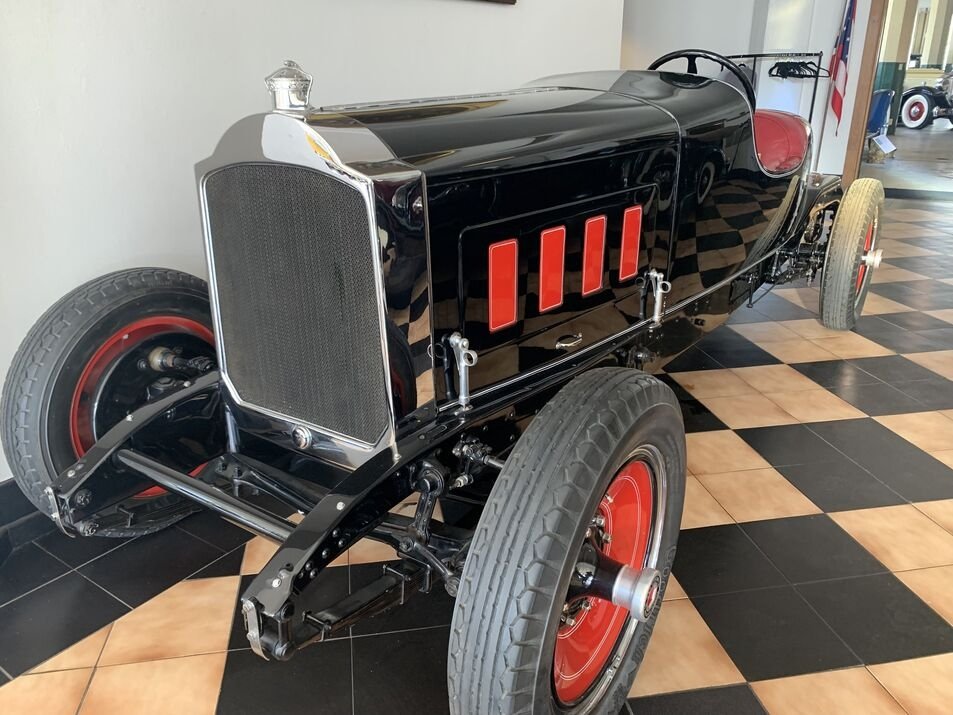
In 1927, Jesse Vincent, head of Packard Engineering, was given permission to build a special speedster to demonstrate the abilities of the 2 1/2 mile banked oval at the newly-constructed Proving Grounds. He used the opportunity to construct this wonderful car, the 1928 Jesse Vincent Speedster, which was used not only to impress celebrities and dignitaries, but to serve as a testbed for much of the Speedster-series drivetrain parts. It was constructed using the lightest single-six chassis, the largest (and highly modified) straight eight engine, and a special lightweight and aerodynamic aluminum body. It was clocked at over 129 mph on the oval track, and was often used by Vincent to commute from his home on Grosse Pointe! In 1929, Charles Lindberg drove the car at 112 mph, saying it was the fastest he had ever gone “…on the ground.”
Curator Stu Morris drives the 1928 Jesse Vincent Speedster
1928 Jesse Vincent Speedster
385 cu. in. straight eight. 130 BHP @ 3000 rpm. 3-speed manual transmission. 126” wheelbase. Not offered for sale. Donated by Carl Schneider
In 1928…
Penicillin is discovered.
Bubble gum is invented.
Chrysler and Dodge Brothers merge.
Cost of a new house: $4,250.
Average yearly wages: $1,490.
Gallon of gas: $0.21.
Average cost of a new car: $600.
The Automotive Hall of Fame inducted Jesse Jesse Vincent in 1971. His citation reads:
Jesse Vincent helped shape Packard into one of America’s most respected automobile manufacturers… Vincent began his career in the auto industry in 1910, when he became chief engineer for Hudson Motor Car Company. He worked at Hudson for two years before moving on to Packard in 1912. He made immediate improvements to Packard’s existing straight-six and also developed the famed “Twin Six” V-12, Packard’s answer to Cadillac’s first V-8. Vincent also oversaw the design of the Packard straight-8 and would later establish the Packard Aircraft Engine Department, which would aid in the development and assembly of the famed V-12 Liberty engine. When the U.S. entered WWI in 1917, the federal government contracted with noted engine designers like Vincent to create a reliable aircraft engine that could be mass-produced. Vincent was commissioned as a major in the U.S. Army and designed the Liberty V-12 in collaboration with Elbert Hall and Howard Marmon. Over 13,000 Liberty engines were produced by various manufacturers before the end of the war and Vincent would retire from the Army as a full colonel.
Vincent remained Packard’s head of engineering until he retired in 1946, leaving his mark on virtually every Packard produced since WWI. By acting on the principle that no one succeeds alone, Jesse Vincent helped Packard achieve outstanding success during his 33-year career.